
Best Marketing Agency for Small Business: 2026 Guide
Here’s a scene that plays out in small businesses every month. You sign with an agency, pay the first invoice, and wait. Six months later you get a report full of impressions, reach and follower counts.
The best marketing agency for small business doesn’t produce that report. It tells you what you’ll pay before the first call ends, lets you buy only the services you need, and shows you which spend produced which customers. This guide covers how to spot that kind of agency, when it makes sense to hire one at all, and which warning signs should end the conversation early.
What makes the best marketing agency for small business?
The best marketing agency for a small business has four traits: transparent pricing you can read before talking to sales, flexible services you can start small with, ROI tracking tied to leads and sales instead of vanity metrics, and short contracts you can leave without penalty. If an agency misses one of these, keep looking.
Notice what’s missing from that list: awards, a fancy office, a client roster full of famous brands. Big-name clients often mean the opposite of what you need. An agency used to six-figure monthly budgets may treat your account as filler.
When should you hire a digital marketing agency?
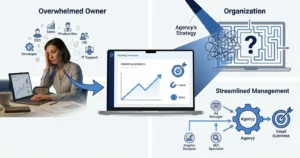
Hire one when marketing has become the thing you keep postponing. If you’re the owner, the salesperson and the person posting on Instagram at 11 pm, something has to give.
These are the moments when an agency starts to pay for itself:
- You have a product that sells, but leads come only from word of mouth, and growth has flattened.
- You’re running ads or an SEO plan yourself and can’t tell whether any of it works.
- Your website exists, but nobody finds it and nobody fills in the contact form.
- You’ve hired a freelancer for each task and now spend your week coordinating them.
And when should you wait? If you can’t yet handle the enquiries you already get, more leads will only make things worse. The same goes if you can’t commit at least three to six months of budget. SEO in particular needs that long. An agency can’t fix a product nobody wants, either, though some will happily take your money while pretending they can.
Pricing transparency: the first filter
Start here, because it’s the fastest test. Ask what a month of work costs and what’s included. A good agency answers in plain numbers. A weak one says “it depends” and books you a discovery call so a salesperson can size up your budget.
Some pricing depends on scope, and that’s fine. But the agency should still be able to say “our packages for businesses your size usually run in this range, and here’s what moves the price up or down.”
Watch for two traps. The first is the low entry price that balloons through setup fees, “management fees” and a percentage of ad spend you never agreed to. The second is the opposite: a flat, vague retainer with no list of deliverables, so you can’t tell afterwards whether the work was done.
A simple habit helps. Before you sign, ask for a written list of what you’ll receive each month: how many blog posts, how many ad campaigns managed, how many reports, how many calls. If it isn’t written down, it won’t happen.
Service flexibility: buy what you need
Small businesses rarely need everything at once. A new local clinic might need a Google Business Profile, a decent website and review management. An online shop might need ads and email. Nobody needs a 12-channel strategy deck.
Two models work well. One is a full-service agency that lets you start with a single service and add others later, so you eventually get SEO, paid ads, social media and web development under one roof without coordinating four vendors. The other is a specialist who does one thing exceptionally well and says no to the rest.
The model that fails small businesses is the rigid bundle: a fixed package of services you mostly don’t use, locked in for twelve months.
Two questions will expose rigidity quickly. Can I change my package after three months? And what happens if I want to pause for a month? An agency confident in its work will say yes to both.
ROI tracking: what real reporting looks like
Impressions are free to generate. So are likes. Neither pays your rent.
Good reporting starts from the end of the funnel and works backwards. Before any campaign launches, the agency should agree with you on what counts as a result: a phone call, a form submission, a WhatsApp enquiry, a sale. Then it should set up the tracking to count them.
Ask to see these things:
- Conversion tracking on your website forms and checkout, set up in your own analytics account (not the agency’s).
- A monthly report that shows cost per lead and, where possible, cost per customer.
- Plain-language notes on what changed, what worked, and what they’ll do next month.
Here’s a worked example. Say you spend 20,000 a month on ads and the report shows 40 leads. That’s 500 per lead, which sounds fine until you learn only 4 of them became customers. Your real cost per customer is 5,000. If a customer is worth 3,000 to you, the campaign is losing money no matter how healthy the lead count looks. Only an agency that tracks down to the sale can show you that.
One honest caveat: attribution is never perfect. A customer might see your Instagram post, search your name two weeks later and call. Good agencies admit this and explain how they handle it. Be suspicious of anyone who claims perfect numbers.
Red flags to avoid
Most bad agency relationships show warning signs in the first meeting. Walk away if you see these:
- Guaranteed rankings or guaranteed results. Nobody controls Google. Anyone promising the number one spot is either lying or planning something that will get your site penalised.
- Long contracts with heavy exit penalties. If they need to trap you, the work probably won’t hold you.
- No access to your own accounts. Your ad account, analytics and website should be in your name. An agency that owns them owns your leverage.
- Reports full of vanity metrics. Reach, impressions and followers with no connection to enquiries or sales.
- Nobody can name who’ll actually do the work. If the person selling isn’t the person working, ask to meet the second one.
- Pressure to decide today. A real offer will still be there tomorrow.
- One-size-fits-all packages. If they pitch you the same plan they’d pitch a hotel chain, they haven’t listened.
- Vague answers about tools and methods. You don’t need to understand every detail, but you should be able to ask “how?” and get a straight reply.
What an affordable, full-service agency looks like
A small business needs a different kind of agency from an enterprise brand, and the difference shows up in the model. Agencies built around growing small brands, such as Innovative Digital Marketing, tend to organise their work around the problems in this guide: pricing scaled to a small budget instead of an enterprise retainer, a single team covering SEO, paid ads, social media and web development, and reporting that points to measurable results instead of impressive-looking charts.
That combination matters because small businesses can’t afford the usual trade-off. Enterprise-level agencies give you depth and charge for it. Cheap freelancers give you low prices but leave you managing the pieces. A full-service agency priced for small brands sits between the two: one point of contact, a team that can move across channels, and a monthly cost that doesn’t need board approval.
Whichever agency you shortlist, hold it to the same standard. Ask the questions below and compare the answers.
Questions to ask before you sign
Take this list into every sales call. Agencies that welcome these questions are usually the ones worth hiring.
- What exactly will I receive each month, and what does it cost?
- Are there setup fees, management fees or ad-spend percentages on top?
- Who will work on my account, and can I speak to them before signing?
- How will you measure results, and what counts as a win for my business?
- Will my ad, analytics and website accounts be in my name?
- What’s the minimum contract, and how do I leave?
- Can I add or drop services after the first few months?
- Can you show me a sample report from a client with a similar budget?
If an agency dodges more than two of these, trust the dodge.
Frequently asked questions
How much should a small business spend on a marketing agency?
There’s no honest universal number. A common rule of thumb is to set aside roughly 7 to 8 percent of revenue for marketing overall, though it varies by industry and by how fast you want to grow. A newer business chasing growth often spends more; a steady local shop with strong referrals spends less. Start with a budget you can sustain for at least six months, then ask agencies what that amount realistically buys.
How long does it take to see results from a marketing agency?
Paid ads can produce leads within weeks, though the first month is mostly testing. SEO usually needs three to six months before rankings and traffic move in a meaningful way. Social media sits somewhere between the two. Be wary of anyone promising overnight results, and be equally wary of an agency that can’t tell you roughly when you should expect to see the first signals.
Is a full-service agency better than hiring a freelancer?
It depends on what you need. A freelancer is a good fit when you have one clear task, such as designing a logo or setting up a website. A full-service agency makes more sense when several channels need to work together and you don’t want to coordinate them yourself. Either way, apply the same tests: transparent pricing, real tracking, and no lock-in.
Can I switch agencies if it isn’t working?
Yes, as long as you control your own accounts and your contract lets you leave. This is the main reason to insist on account ownership and short terms before you start.
Final thought
Choosing an agency is mostly an exercise in asking uncomfortable questions politely and noticing who answers them. The agency that shows you its pricing, lets you start small and counts customers instead of clicks is the one worth your money, whether that’s a boutique specialist, a full-service team like Innovative Digital Marketing, or somebody you haven’t found yet.
Set your budget, write down what a result means for your business, and start asking.